

Guide · wind ratings
Wind ratings decoded: what N1 to C4 really mean for your garage door
N1 to N6 and C1 to C4 are wind classes for the house site, not ratings on a garage door, and the building code's garage-door rule turns on the wind region your home sits in. It covers Regions C and D, where the C classes apply, and a door there must meet AS/NZS 4505.
The garage-door rule reads the wind region, not a label on the door
| Wind region | NCC 2022: site classes | NCC 2022: garage-door rule applies? | NCC 2025: site classes | NCC 2025: garage-door rule applies? |
|---|---|---|---|---|
| A | N1 to N6 | No | N1 to N6 | No |
| B1 | N1 to N6B1 and B2 read as Region B | No | N1 to N6 | No |
| B2 | C1 to C4 | Yes | ||
| C | C1 to C4 | Yes | C1 to C4 | Yes |
| D | C1 to C4 | Yes | C1 to C4 | Yes |
| Wind region | A | B | C | D | |
|---|---|---|---|---|---|
| Site classes | N1 to N6 | C1 to C4 | |||
| Garage-door rule applies? | No | Yes | |||
| Wind region | A | B1 | B2 | C | D |
|---|---|---|---|---|---|
| Site classes | N1 to N6 | C1 to C4 | |||
| Garage-door rule applies? | No | Yes | |||
Door rule covers openings not more than 3 m high in external walls.
Your building paperwork might say N2, or a listing up north might say C2. Either way, that label describes the house site. It does not describe the garage door, and it does not decide whether the door has to meet the wind standard. The building code's garage-door rule reads something else: the wind region.
Put the ABCB's own pages side by side and the two line up.
Under NCC 2022, the edition NSW uses now, the NCC 2022 Housing Provisions glossary places N1 to N6 in "Non-cyclonic Region A and B". The garage-door clause in NCC 2022 Housing Provisions Part 2.2 covers garage doors and other large access doors in openings not more than 3 m high, in external walls in "wind region C or D" (clause 2.2.4). Those doors must meet AS/NZS 4505. Western Australia's version of the clause says "wind region B, C or D", because WA also counts Region B as cyclonic.
The two lists start in the same place. N classes sit in Regions A and B, and the door rule starts at Region C, where the C classes start.
NCC 2025 moves both lines together. The NCC 2025 Housing Provisions glossary groups C1 to C4 under "Cyclonic Region B2, C and D". The NCC 2025 Housing Provisions Part 2.2 door clause names "wind region B2, C or D". Those are the same three regions.
So here is the one correction worth carrying away. A garage door does not carry an N or C class at all: the class belongs to the house site, and the NCC door rule turns on the wind region the building sits in.
What do N1, N2, N3 and C1 to C4 mean?
AS 4055 covers houses up to two storeys, no wider than 16 m, no higher than 8.5 m; outside that, AS/NZS 1170.2
They are site wind classes from AS 4055:2021 "Wind loads for housing". The standard sets them for Class 1 and Class 10 buildings, the code's labels for houses and their outbuildings. Once a site has its class, the standard is used to work out forces on the house, such as uplift on the roof and racking of the walls. AS 4055 is referenced in NCC Volume Two.
There are ten classes. The AMIA wind classification guide, an industry explainer, lists them as N1 to N6 for non-cyclonic sites and C1 to C4 for cyclonic ones. A higher number means a higher design wind speed.
AS 4055 has limits. The same guide says it suits houses up to two storeys, no wider than 16 m and no higher than 8.5 m. Anything bigger is designed to AS/NZS 1170.2 instead.
How does a site end up with its class?
Source: AMIA, NEMA, ABCB, Geoscience Australia
Four site factors set the class: wind region, terrain category, topographic class and shielding class. The AMIA wind classification guide lists all four. The NEMA page on wind classifications for contractors, builders and designers, which hosts a Cyclone Testing Station video, walks through the same four steps to "Table 2.2".
In plain terms:
- Wind region is the broad zone on the national map.
- Terrain is how rough the ground upwind is. Open paddock lets wind build. Rooftops slow it down.
- Topography is whether the house sits on a hill, ridge or slope.
- Shielding is how many houses and trees stand around it.
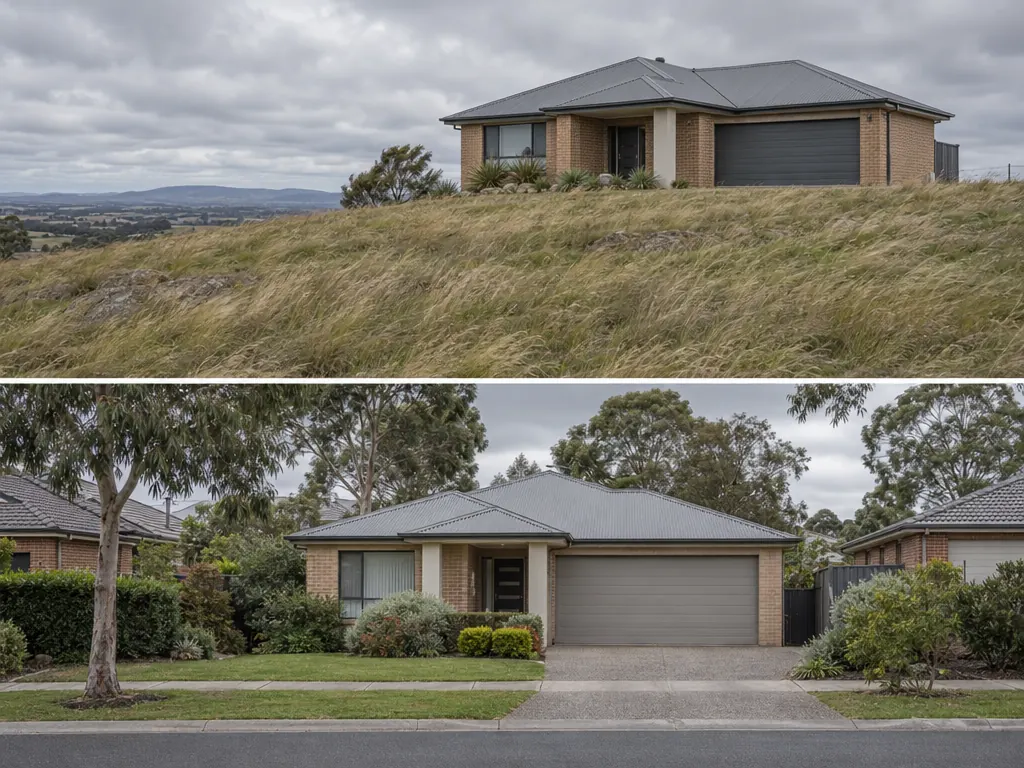
Two houses in the same region can land on different classes. The ABCB publishes a Western Australian site-classification table as part of WA's variation. We use it here only to show how the factors combine. Its Region A rows run from N1 to N5, with flat, sheltered sites at N1 or N2.
The region itself comes from AS/NZS 1170.2, which defines regions A, B1, B2, C and D. Don't read your region off a web map. Geoscience Australia's wind region dataset says its map is "not suitable for design purposes", and that the Standard's Figure 3.1 prevails. Your certifier or council can tell you which region your house is in.
Is my garage door wind rated?
The door itself does not carry an N or C class
Ask a different question: does your house sit in a region the code names for garage doors? If it does, the door in an opening up to 3 m high needs to meet AS/NZS 4505, under NCC 2022 Housing Provisions Part 2.2.
Our advice at Steady Garage Doors is to hold the paperwork rather than chase a letter-and-number label. Ask the supplier for the door's test and certification documents, and keep them with the house papers. If a door is sold to you as "N3" or "C2", ask what that refers to. The class belongs to the site, not the door.
Why does one door matter to the whole house?
Garage door closed and holding
Garage door gone
Along the load path, roof to footing
- anchorage
- bracing
- continuity
Source: ABCB
A garage door is often the largest opening in a house. That makes it part of the building's wind design, not just a way in for the car.
The openings clause Western Australia puts in place of the one in AS/NZS 1170.2, printed in the ABCB's Western Australian Part 2.3 variation, treats normally closed doors, "including large access doors (e.g. roller doors)", as openings. That holds unless they are shown capable of resisting the wind pressures applied to them. Large openings raise internal pressure.
Picture wind getting into the garage. It pushes up on the roof from inside while the same storm pulls at it from outside. In cyclonic areas, the ABCB explains that a building resists wind through an anchorage system, a bracing system and continuity between its elements. A door that gives way breaks that chain at the front of the house.
Storm season matters here too. The NSW SES puts storm season between September and April. Our guide to getting the garage door storm-ready covers the practical checks.
Who needs to think about the C classes?
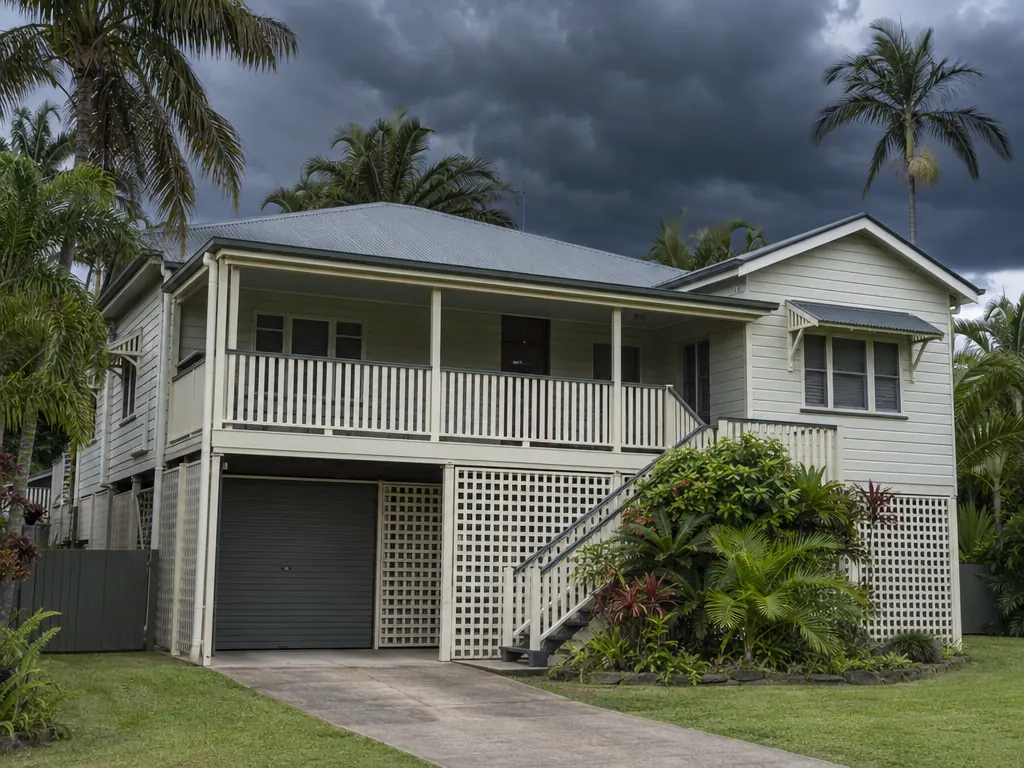
Under NCC 2022, the ABCB glossary places C1 to C4 in "Cyclonic Region C and D". If you're buying a holiday or investment home in the tropical north, or moving there, those classes will turn up in the building and pest report, the plans and the certifier's paperwork. Ask which region the house is in, and whether the garage door has AS/NZS 4505 paperwork.
Closer to home, don't assume your region from a neighbour's plans or a map online. Ask your certifier or council. The answer settles whether the door rule applies to your house. A label on the door cannot.
Is the rule changing in NSW?
29 July 2025
NCC 2022 Amendment 2 in effect in NSW.
Garage-door rule: wind region C or D
1 May 2027
NSW adopts NCC 2025.
Garage-door rule: wind region B2, C or D
Source: NSW Government, ABCB
Yes, on a set date. NSW currently runs NCC 2022 Amendment 2, in effect from 29 July 2025. The ABCB's NCC 2025 state and territory adoption information shows NSW adopting NCC 2025 on 1 May 2027.
The garage-door wording widens at that point, from "wind region C or D" in NCC 2022 to "wind region B2, C or D" in NCC 2025. What that means for a particular house depends on its region, so it's a question for your certifier if you're building or replacing a door around the changeover.
The figures side by side
10 site classes: N1 to N6, C1 to C4
AMIAGarage-door rule, NCC 2022: openings up to 3 m high in wind region C or D
ABCBGarage-door rule, NCC 2025: wind region B2, C or D
ABCBNSW adopts NCC 2025: 1 May 2027
ABCB adoption pageThere are ten site classes, N1 to N6 and C1 to C4. They describe the land the house stands on.
The garage-door rule reads the wind region, and covers openings up to 3 m high. Under the code NSW uses now, that is Region C or D. From 1 May 2027 in NSW, it is B2, C or D.
Your next step
If you're weighing a new door, buying a house with an older one, or you just want to know what paperwork your current door came with, start with two facts. First, the wind region from your certifier or council. Second, whatever documents you already hold for the door. Then send Steady Garage Doors an enquiry with both, and we can talk through what fits your opening.
Sources
- https://www.abcb.gov.au/editions/ncc-2022/adopted/housing-provisions/1-definitions/glossary
- https://www.abcb.gov.au/editions/ncc-2025/adopted/housing-provisions/1-definitions/glossary
- https://ncc.abcb.gov.au/editions/ncc-2022/adopted/housing-provisions/2-structure/part-22-structural-provisions
- https://ncc.abcb.gov.au/editions/ncc-2025/adopted/housing-provisions/2-structure/part-22-structural-provisions
- https://ncc.abcb.gov.au/editions/ncc-2022/adopted/housing-provisions/11-western-australia/23-changes-asnzs-117022021-and-40552021
- https://ncc.abcb.gov.au/ncc-2025/ncc-2025-state-and-territory-adoption-information
- https://www.nsw.gov.au/housing-and-construction/compliance-and-regulation/how-to-comply-national-construction-code
- https://hia.com.au/resources-and-advice/building-it-right/australian-standards/articles/wind-loads-for-housing
- https://amia.com.au/resources/wind-classification-guide/
- https://www.nema.gov.au/our-work/resilience/national-resilience-action-library/information-contractors-builders-and-designers-wind-classifications
- https://ecat.ga.gov.au/geonetwork/srv/api/records/74dfa021-95cd-4090-9e25-a7a8efde5454?language=eng
- https://www.ses.nsw.gov.au/stormseason
Pictures in this guide are illustrations, not photos of our jobs.